My main area of interest appears to be green models from the Allied WWII European Theatre - 1944-45.
I go astray a few times, but usually go back there.
I am not a master modeler and I am not showing off, just using this as a venue to express myself and show people who are interested in this kind of stuff what I have done.

Saturday, 29 March 2014

Canadian LAV III Afghanistan - Update March 29, 2014

I got real intense with this one back January, but I seemed to tail off in Feb and March, a lot of little photo etch parts, a lot of research, I had to take a break.

I went back at it again this week with a renewed enthusiasm and made some progress. Not quite done yet. I still have the lights, light guard, rear view mirrors and a few other plastic things to do, but I think the lions share of the photo etch is complete.

And I stuck my fingers together, finally.

I have posted some pictures from today down below to show current state.

Also included in the pictures is a picture of a new addition to my work bench. We had a 32" LED TV left over from an upgrade for one of the boys for Christmas, so I set it up in the basement on a new section of my bench. With an old laptop connected to the screen, networked to the home network, I have access to my recorded TV shows, my research material, and online instruction sets, and anything I need. Works out well for me.

One other thing I made, especially for this model, was a turn stable/stand, it allows me to rotate the kit without touching it. Touching is a very sensitive subject with this one, with so much photo etch and CA glue, it doesn't take much for small parts to come flying off onto the work bench or floor. I got the hardware from, were else, the hardware store.. It is the Lazy Susan hardware, basically two thin sheets of steel with a ball bearing mechanism between. You can buy them in 3" and 4" sizes, this one is the 3 inch. It cost about $5.00. I cut two circles out of 1/2 inch MDF board, and screwed it in pace with 3/4 inch #8 screws. I then took some kitchen no-skid matting that you would use in the cupboard for putting dishes on, cut it to fit and white glued it down to the wood, so the kit doesn't slide. Works for me!

Until next time..


Bench

Turn Table


Friday, 14 February 2014

Canadian LAV III Afghanistan - Update February 14, 2014

Photo Etch - daunting yes, working OK so far? Yeah, but let's not jinx it!

If I thought there was going to be one huge challenge to this build, it would be the turret baskets. I have no idea how to go about it, the conversion kit did not have any instructions, but I did see a lot of reference photos of other builds and Prime Portal has an excellent Walk Around.

I figured I would try to tackle it now, instead of get further down the road and abandon it after I put a lot of work into it.

So looking at finished products, I worked backwards. I started with the rear basket, it looked the easiest, relatively speaking. After a lot of tweaking, cutting, filing, bending (Thanks to the Etch Mate!), ripping apart and rebuilding (CA Glue and Photo Etch CAN be unbuilt without too much damage).

All I had was no reference to what should be some photo etch (200 pieces on 5 sprues) for the frame supports and mesh sides and bottoms, and some lengths of 1 mm brass wire. And a resin template for the wire bends. So looking at the pictures, and looking and dry fitting a hundred times, and 4 hours, I got the rear basket completed and attached. Not perfect, but looks good to me. I have lots of accessories to fill that basket.

Today was a vacation day, so with me feeling pretty good about myself and the new rear basket, I attempted the side baskets. Using the same methodology and building both at the same time, again, I amazed myself and did what I thought was an acceptable job. Again, lots of things to put in those baskets to cover up any glaring flubs.

Taking a break... If you are keeping track, I never glued my fingers together yet.

Here are some progress pics.
Yes, some tie downs from the other night...  SMALL...patience! Those squares on the cutting mat are 1/2 inch (12 cm).


Foreground left, Resin template for basket tube frames.. Thanks Miroslav!


I set up the top rail first with the photo etch supports as a guide. The rest had to fit that to remain square. The bottom of the basket has Photo etch mesh as the floor and lower sides so the rations and water didn't fall out. Spare photo etch sprue frames acted as basket supports and mesh reinforcement. Its on the real thing!


There!

Side basket construction.

More of the same but doubles. This is a redo, had to take the frame supports off, one of the rails stuck out too far.. didn.t dry fit enough :(


Et Voila!

Another Angle .. Basket Weaver!!!!!!!!!!!


Monday, 10 February 2014

Canadian LAV III Afghanistan - Update February 10, 2014

I have been carefully preparing this for build, my most ambitious to date. As I mentioned, I did about 2 weeks of research and was, and still am, sure of what I want to do.

I started working on the resin pieces getting rid of the mold blocks and sanding where required. I wanted to get that out of the way first off so I could go right to dry fitting. All while wearing my trusty respirator. (Resin baaaad!))

The first fit I went after was the rear bulkhead, which was a donor kit piece which glues to the rear of the vehicle. The top half of the hull is resin, the bottom half of the hulk is plastic. So the bulkhead mates the two on the rear.

The fit is not exact. The AFV rear bulkhead needs to be trimmed on the top edges to match the contour of the top of the LAV hull, which is not the same as a Stryker. The Stryker is squared edges, the LAV has bevelled edges. The resin hull sides do not go back far enough, so I had to use some Evergreen 40 thou by 10 thou strips to extend the upper sides, which you can see in white, with white Squadron putty filling the seams. This took a few days of careful dry fitting and trimming.

I am using Testors tube cement and liquid cement on the styrene to styrene fits, and using thick CA glue for the resin to plastic fits (and everything else as well, like metal photo etch to resin or plastic).


The next big step was to articulate the front wheels to pose it as if making a turn. The undercarriage for the AFV kit is fixed forward, but I wanted a turned look for this one. Both front wheels turn so I have to do the same operation twice. The wheels mounts are posts set into the roof of the wheel well. The swing arms hold the posts to the chassis, and the posts can turn until they are glued. The challenging part was to cut the steering linkage apart to make it articulate like the real one. I used a razor saw for this. I carefully cut off the pitman arms from the tie rods and center link. I then used a small drill to drill out the ends of each. I glued Evergreen rod in to the pitman arm holes and let it dry. I dry fitted the tie rods and pitman arms to the model, and put the center link in place. I did the rear first, in an understated turn, then did the same for the front, using a slightly increased turn, just like the real thing. When everything looked right I glued everything in pace, all the ends of the tie rods to the pitman arms and wheel posts, and the center links to the pitman arms. While the glue was setting, I posed the wheel posts exactly where I wanted, then I glued the swing arms to the posts with liquid glue. All of this set over night.


The next day I dry fitted wheels to the wheel posts to check to make sure it was right. I think it looks OK.


After that it was some plastic handles, and other parts from the donor kit. The instructions are very busy and it took a lot of focus to see which little parts were needed and what were resin. I will go over it again to see if there are any parts missing but I have the rest of them in a bin and will put them on before painting. It takes a while to remove sprue marks and mold seams. Very tiny parts, AFV is getting like Dragon in the detail. I will be doing a lot on handling as I put on the photo-etch, so I will be leaving those parts off for now, and there is a lot of photo-etch!


So the next step was to start laying in some photo-etch. I am sure that photo-etch gives most modellers the creeps every now and then, and if the pieces are large enough to work with that is fine. There are some VERY small pieces in this set. I cringe when I think of the little attachments for tie down straps. I have to put the maximum magnification on my goggles. Try doing this with Super Glue and not sticking your fingers together! Keep the debonder close by!


So this is pretty much where I am now, the front drivers hatch is on, with a nifty black plastic/rubber cover over the rear so garbage, water and hot casings don't drop on the drivers neck as he opens his hatch. A start tot he photo-etch pieces but will let is sit for a day or so to dry and bond completely.


Stay tuned.

Monday, 27 January 2014

Now working on - Canadian LAV III Afghanistan

Most modelers usually have a couple of things on the bench, and I do..


But something came along that made me put them up on the shelf and take on something new. It all started when a local modeler was thinning his stash and asked me to help pass the word. I looked at the list, but promised myself to hold back. But then I said, I will just look at taking a few things, just to help out a fellow modeler. And it may have just stopped there if I had sent the list in to him and he produced JUST THAT. But no, I decided to drop over and pick up the stuff I wanted.

Now this stash had a little bit of WWIII and A LOT of modern armor. From what you have seen here on this blog, you know I am not a modern guy.

Well,  that all changed when I saw the Real Model RM35125 LAV III Resin Conversion Kit. This guy had ALL the things needed to take an AFV Stryker (any one will do) and turn it into a Canadian LAV III from the 2000-2007 period.


I was interested in the Afghan conflict, since a friend of mine from my army days in the early 80s was a platoon warrant in 1 PPCLI Battle Group in Afghanistan from Jan-Aug 2006, when things really heated up. I also have a nephew who did two tours there later. The LAV, as a military vehicle, was an interesting modeling subject, one that I had considered before, but  was concerned that there were no ready-to-go kits available, without putting a lot more work into it that I didn’t think I could accomplish.
So when I saw this: the AFV Stryker kit, the Real Model conversion kit, and a load of accessories (Gas cans, stretcher, ration boxes, equipment, etc -  I said, yeah I can do this.  So in addition to the things on the list, and for a few more bucks, I took it home.


I spent about two weeks researching pictures and other builds. I was concerned about making sure that the configuration of the kit, upgrades and accessories accurately depicted a LAVIII that could have existed at a specific time. I won’t go into a history of the evolution of the LAV III operating in Afghanistan with Canadian Forces, but there was a steady stream of modifications (armor/electronic upgrades, storage, etc) that it would not be hard to build a vehicle that had never existed.  Through the pictures and model build logs and some help from Anthony Sewards on the Canadian Armor forum, I landed on a vehicle from the late 2007/early 2008 period. The most significant differences would be the rear air sentry blast shields are in place, and the antennae use the rear T mounts. It would also have the armored gas tank covers.

I am ready to start…………….


Wednesday, 4 December 2013

Sunday, 1 December 2013

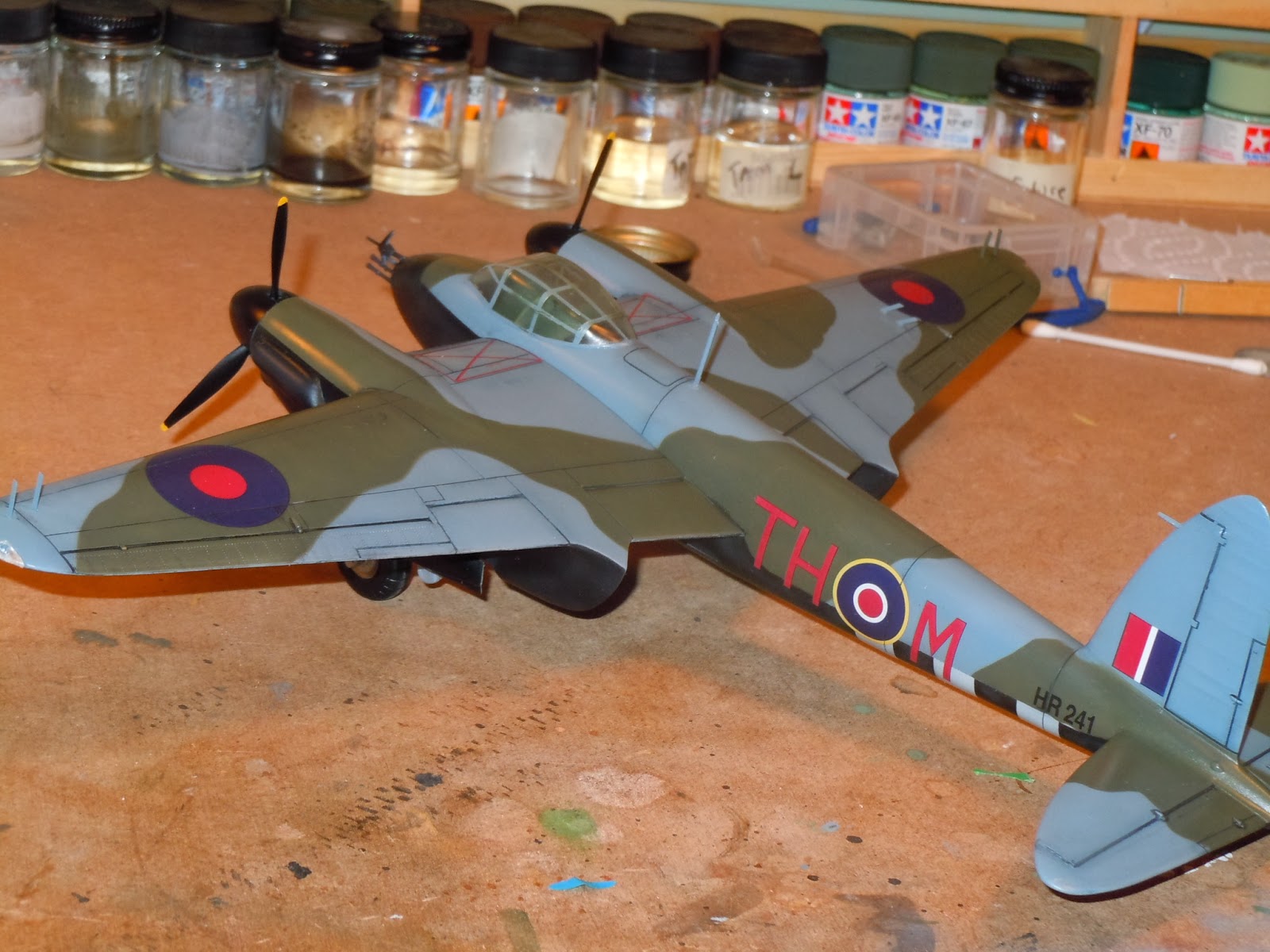
Revell Mosquito Update 2 - Dec 1

Almost done.

Painted the Base Coat/Camo.
My methodology is to paint the lightest coat first, in this case the Sea Grey on the top sides, everywhere, as if it was going all Sea Grey.
Next would come the Dark Green. To get the camo pattern, I referred to Type B RAF Camo pattern for Mosquito (came with Tamyia kit) and drew it in pencil on the Sea Grey. Then I masked it out using blue sticky tack for the hard edges, and filled in the open space (that stay Sea Grey) with green painters tape, cut to rough shape as needed, but the paint will be airbrushed against the sticky tack. I find White Stickytack WAY too sticky, and Yellow only marginally less sticky. Blue works for me.
After the Green was put on, I masked the entire upper camo and applied the Black to the bottom.

If this had been a day fighter, I would have done the reverse, start with the light grey on bottom, the sea grey, and finally green.

When that was dry, I shot the whole thing with Future floor polish (Klear, etc where different brands exist).
When the clear was dry, I applied all the decals using the Micro Set/Sol method.  I have to say that the Revell decals were a bit thicker than others I have used and it took a bit of work to set them just right to hug down on the detail, many, many coats of Sol. Similar to the Revell P-51D Mustang (Big Beautiful Doll) actually. A day later I shot it with Future again to seal the decals and reduce the decal ridges.

Today I did the sludge wash for the recessed panel lines. I mixed some flat black enamel 50/50 with thinner. Future is acrylic based, so doing the acrylic/enamel/acrylic/enamel, etc layering method, I had to use enamel paint in order not to mar the previous work. After leaving the paint on for about 10 minutes, I wiped away the excess paint with a thinner soaked (very slightly wet/almost dry) paper towel. I was left with what you might call a Pin Wash in the recesses that act as shadows for the panel lines and really draws the lines out. Have a look for yourself below.

Tomorrow night is a covering of Dullcote to reduce the shine to a dull (but not flat) finish. Just in time for Tuesday Nights Model club meeting.

I will post some final shots with the Dullcote and better lighting in a few days.

Just a reminder - Canadian content here folks....
RCAF 418 Sqd 1944/45 (Intruder)
Not sure when this particular Color Scheme was in use....


Motto:
Piyautailili ('Defend Even Unto Death') (Inuit)
City of Edmonton Squadron
Squadron Code(s):
TH
Dates Mosquitos on Squadron Strength:

February 1943 to September 1945
Mosquito Variant(s) Flown:
FB.VI (February 1943 to September 1945)
Main Base(s):
Bradwell Bay (February 1943)
Ford (14th March 1943)
Holmsley South (April 1944)
Hurn (14th July 1944)
Middle Wallop (29th July 1944)
Hunsdon (28th August 1944)
Hartford Bridge (21st November 1944)
Coxyde (15th March 1945)
Volkel (25 April 1945 to 7th September 1945)
Commanding Officer(s):
Wg Cdr J. H. Little (December 1942)
Wg Cdr P. Y. Davoud DFC (June 1943)
Wg Cdr D. C. S. MacDonald DFC (January 1944)
Wg Cdr R. J. Bennell (February 1944)
Wg Cdr A. Barker (March 1944)
Wg Cdr R. Bannock DFC (October 1944)
Wg Cdr J. C. Wickett (November 1944)
Wg Cdr D. B. Annan (February 1945)
Wg Cdr H. D. Cleveland DFC (May 1945)

Sunday, 24 November 2013

Revell Mosquito Update 1 - Nov 24

I have never built a Mosquito before, but I think it is one of the most beautiful flying machines ever made, Twin Merlins, made of wood, pretty... what more could you want?

I acquired the Tamiya 48 scale B IV/PR IV Mosquito a few years ago with the intention of doing it shortly thereafter, BUT armour came a calling when Chris Jerrett was putting out some find tank models. Leveraging his tips and knowledge in person on a monthly basis, I wanted to take my Armor skills up a notch. And I think I have, relative to my capabilities and earlier work. You can judge for yourself on this blog over the past few years.

I worked on two models this year, only two.
I have a stash that is not getting any smaller, and a best before date on me that is not moving.

So I want to do more, quicker. Like after the last show, I went back to planes hoping to do quicker builds, and I went after the Mosquito, but not the Tamiya one. I bought the Revell 48 scale RCAF Mosquito a couple of moths ago so that I would be more familiar with the shapes and parts, so a practice run before I went to the Tamiya kit.

I am a ways down the road on this one. It is primed and preshaded, just waiting to do the camo pattern and decals. The kit is not Tamiya, I will just put it at that. There are obviously a lot of short cuts, lack of detail, and the quality is not as good as Tamiya, but it gave me a chance to assemble and for me the hardest part, practice the finish on the seam lines.

I am trying something new here as well. Fellow club member John showed me how he uses Bare Metal Foil to mask the panel lines, so with a quick trip to eBay, I had some. You can see the canopy is covered with it. When the painting is done, I just jab a corner with a tooth pick and get the tweezers to lift it off. I am expecting just a small bit of adhesive residue, but if I leave the paint a few days, I should  be able to rub it off all right.

We will see.

What I have so far.


Sunday, 27 October 2013

An interesting look at The Hobby

Our own Andy from IPMS St. John's (and recent Peoples Choice winner at our show, with - what else? - A Spitfire!) found this link and forwarded it on to me.

I think this is absolutely brilliant on SO many levels.

When you have an hour, no matter what your age, ESPECIALLY if you are young and new to the Hobby, or even if you are not into the hobby, this will give you pause to think.

http://www.youtube.com/watch?v=FzT3L3gGrew

Watch it, and please comment on your thoughts...